Istanbul has two international airports on two continents. Istanbul Airport (IST) is on the European side, north-west of the city; Sabiha Gökçen (SAW) is on the Asian side, to the south-east. If your tickets were booked separately — a long-haul flight into one, a low-cost flight out of the other — the journey between them is yours to arrange. It is a simple trip once you know the numbers.
Three ways to get between the two airports
The road between them is about 80 km and crosses the Bosphorus by bridge. Every time below is door to door — from the arrivals hall of one airport to the departures hall of the other.
| Option | Door to door | Changes | Cost | Best for |
|---|---|---|---|---|
| Private transfer | About 1 hour in clear traffic, up to 1 hour 45 at peak times | None — one vehicle | from €68.99 per vehicle, fixed | Tight connections, families, heavy luggage, night arrivals |
| Havaist airport bus | About 2 hours, plus the wait for the next departure | None — direct line | One bus ticket per person | Solo travellers with seven hours or more between flights |
| Metro and Marmaray | About 3 hours | Three changes, four lines | The lowest — paid with an Istanbulkart | Light bags and a whole day to spare |
The private-transfer times come from our own route data for this exact journey: about an hour when the roads are clear, and closer to an hour and three-quarters at the weekday morning and evening peaks.
How much time to leave between flights
The drive is the smallest part of the sum. On separate tickets you enter Türkiye, collect your bags, cross the city and check in again from the beginning. Add the pieces up before you book:
- 1
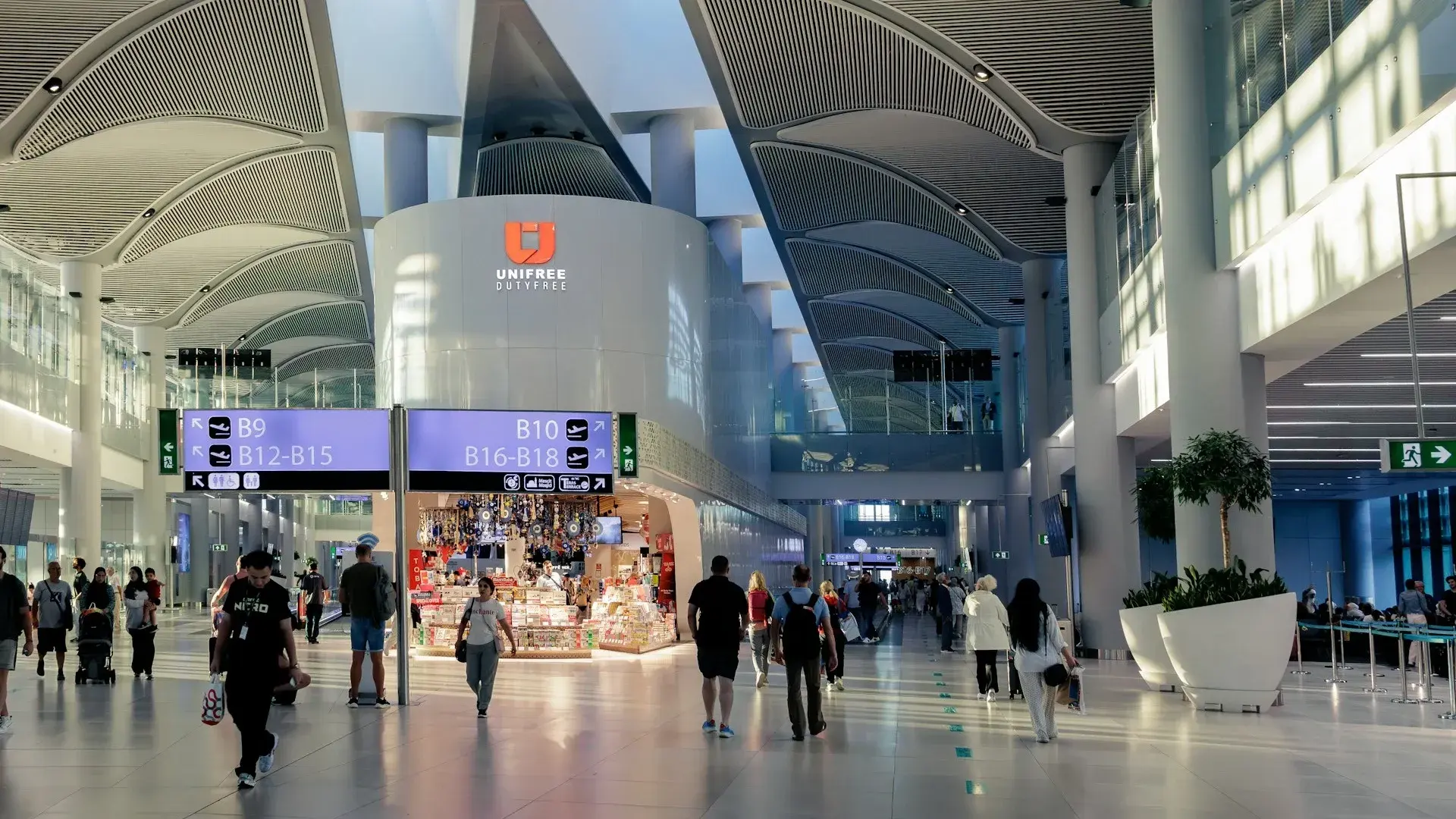
Landing to kerb: 45–75 minutes. Taxiing, the walk through the terminal, passport control and baggage reclaim. Istanbul Airport is one of the largest terminals in the world; the walk alone can take 15 minutes.
- 2
The journey: one to three hours, depending on which of the three options you choose and the hour of the day.
- 3
Check-in closes before departure. Most airlines close international check-in and bag drop 60 minutes before take-off, and some low-cost carriers close earlier. Check your airline's rule — it is the hard deadline of the whole plan.
- 4
Security and passport control again: 30–45 minutes at the second airport, longer in the summer peak.
- 5
A margin for delay. A first flight that lands 40 minutes late is ordinary, not exceptional.
Put together, a sensible minimum is five hours between scheduled landing and scheduled take-off when a private transfer is waiting for you, and seven hours or more if you plan to use the bus or the metro. With less than four hours, look for a different flight.
Each way, honestly
Private transfer. The driver tracks your incoming flight and waits at the airport meeting point, so a late landing does not cost you the car. You walk to a Standard VIP van, the luggage goes in the back, and the next stop is the departures door of the other airport. The price is agreed when you book and is per vehicle, not per person — no meter, and nothing added for traffic or luggage.
Havaist bus. Havaist is the official airport coach operator, and it runs a direct line between the two airports that does not stop in the city. The ride is around two hours. Coaches leave roughly hourly by day and less often at night, so the real cost is the wait: miss one by five minutes and your two hours become three. At Sabiha Gökçen the coaches leave from the open car-park level across from arrivals; at Istanbul Airport, from the ground-transport level below the arrivals hall. Check the current timetable on Havaist's own site the day before you fly.
Metro. It can be done entirely by rail: the M11 from Istanbul Airport to Gayrettepe, the M2 to Yenikapı, the Marmaray under the Bosphorus to Ayrılık Çeşmesi, then the M4 to its last stop, which is inside Sabiha Gökçen. That is four lines and three changes, with escalators and long transfer corridors. It is the cheapest way and immune to road traffic, but it is slow, and the metro does not run through the night. With one cabin bag it is a fine adventure; with two suitcases it is not.
Four things separate tickets change
A connection sold on one ticket is the airline's problem. Two tickets across two airports are yours. Four consequences follow, and all four are easy to plan for:
- 1
Your bags are not checked through.
You collect them at the first airport and drop them again at the second. No airline or handling agent moves luggage between IST and SAW.
- 2
You enter Türkiye.
Changing airports means passing passport control. Check whether your passport needs a visa or an e-Visa before you fly — airlines can refuse boarding without one.
- 3
Nobody protects the connection.
If the first flight is late and you miss the second, the second airline treats you as a no-show. That is the real reason to leave a wide margin, and to choose a flexible onward fare.
- 4
Give your driver both flight numbers.
With the inbound number we follow your landing; with the outbound number the driver knows your check-in deadline and picks the route for it.